




In Stock
Mineral Test Kit
₹1,890.00
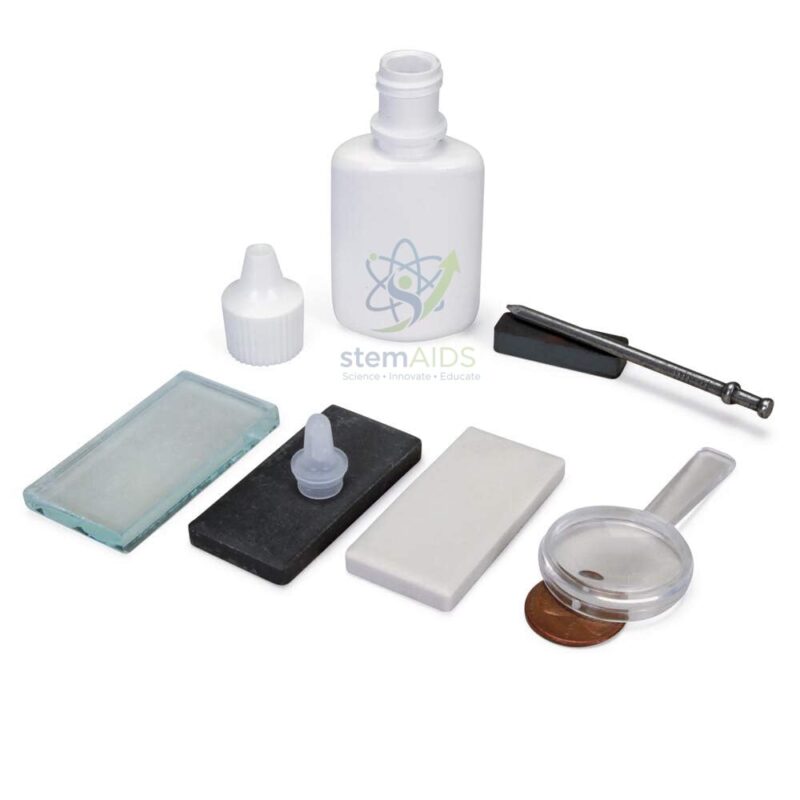
Quick Answer: A mineral test kit is a set of simple tools for identifying minerals by their physical properties. The listing photograph shows white and black streak tiles, a glass plate, a hand lens, dropper bottles, a steel point and a copper coin, which together cover the streak, hardness, lustre and acid tests.
Identifying Minerals Step by Step
Minerals that look alike in colour can often be told apart in minutes with a few standard tests, and this mineral test kit gathers the tools for them. The streak test comes first: rubbing a specimen across an unglazed porcelain tile leaves a line of powder whose colour is more reliable than the colour of the lump. Hematite, for example, can be black, grey or red in the hand but always leaves a red-brown streak. A white tile shows dark streaks and a black tile shows pale ones, which is why kits often include both.
Hardness is tested next by scratching. A fingernail, a copper coin, a steel point and a glass plate give a rough ladder of reference points on the Mohs scale. Students ask whether the mineral scratches the tool or the tool scratches the mineral, and narrow down the range. A hand lens helps with lustre, crystal shape and cleavage, and a drop of dilute acid shows whether a specimen fizzes, as calcite does.
The exact contents of the kit are not stated in the title. The listing photograph shows the items above, but whether the dropper bottles are supplied empty or filled, and whether a magnet or a hardness reference set is included, should be confirmed before the practical is planned.
Applications
- Identifying unknown minerals in rock and mineral practicals
- Comparing look-alike pairs such as quartz and calcite or pyrite and chalcopyrite
- Building a class identification key from test results
- Field-trip identification of specimens collected on site
Specifications
| Item | Kit of tools for testing mineral properties |
| Items shown | White and black streak tiles, glass plate, hand lens, dropper bottles, steel point, copper coin (listing photograph) |
| Tests covered | Streak, hardness, lustre, crystal form and acid reaction |
| Level | Secondary earth science, geography and geology introduction |
| Exact contents and bottle contents | Confirm at enquiry |
Care & Handling
- Wear eye protection when using acid, add only single drops, and rinse specimens and hands afterwards.
- Wipe streak tiles clean with a damp cloth between tests so old streaks do not confuse the next one.
- Keep acid bottles upright, capped and labelled, and store the kit where younger students cannot reach it.
Why Choose LabEquip
Earth-science and geography departments buy mineral test kits in sets so that groups can work through identification practicals. LabEquip lists this kit in Biology Lab Products and offers specimens in its rock and minerals range; the portable ultraviolet light adds a fluorescence test. Confirm kit contents through the LabEquip contact page.
Frequently Asked Questions
What tests can be done with a mineral test kit?
The main tests are streak colour, hardness by scratching, lustre, crystal shape and cleavage under a hand lens, and reaction with dilute acid. Together they identify most common rock-forming and ore minerals.
Why are there white and black streak tiles?
A white tile shows dark and coloured streaks clearly, while a black tile shows white or pale streaks that would be invisible on white. Using both avoids missing a pale streak.
How do the scratch tools relate to the Mohs scale?
A fingernail is about 2.5, a copper coin about 3, and a steel point and glass both about 5.5. If a mineral scratches glass it is harder than about 5.5; if a fingernail scratches it, it is softer than 2.5.
How is the acid test carried out?
Place one drop of dilute hydrochloric acid on a fresh surface of the specimen and watch for bubbling. Calcite fizzes strongly; dolomite fizzes only weakly unless powdered. Rinse the specimen afterwards.
Is acid supplied with the kit?
The listing photograph shows dropper bottles, but whether they arrive empty or filled is not stated. Confirm at enquiry, and follow your school’s rules for storing and diluting acids.
Which minerals are good for practising the tests?
Quartz, calcite, feldspar, gypsum, talc, fluorite, hematite, magnetite, pyrite and galena cover a wide range of hardness, streak and lustre and are easy to obtain as teaching specimens.
Last Updated: September 2026
You must be logged in to post a review.
Bestsellers




Reviews
There are no reviews yet.