



In Stock
Indoor Greenhouse BoQube
Serre d'intérieur BoQube Features a specialized base tray with a channeled water distribution system that prevents root-zone hypoxia while ensuring uniform moisture saturation across the growth substrate.
High-Transmission Ventilation Canopy Engineered with a crystal-clear, UV-stabilized polycarbonate cover and adjustable air-exchange sliders to manage concentrations and prevent fungal pathogens through regulated atmospheric cycling.
₹1,620.00
Quick Answer: The Indoor Greenhouse BoQube is a compact indoor greenhouse: a planting base under a transparent cover, in which seeds germinate and seedlings grow in warm, humid air. Classrooms use it to watch germination and early plant growth up close through the year.
Growing Plants Indoors with the BoQube
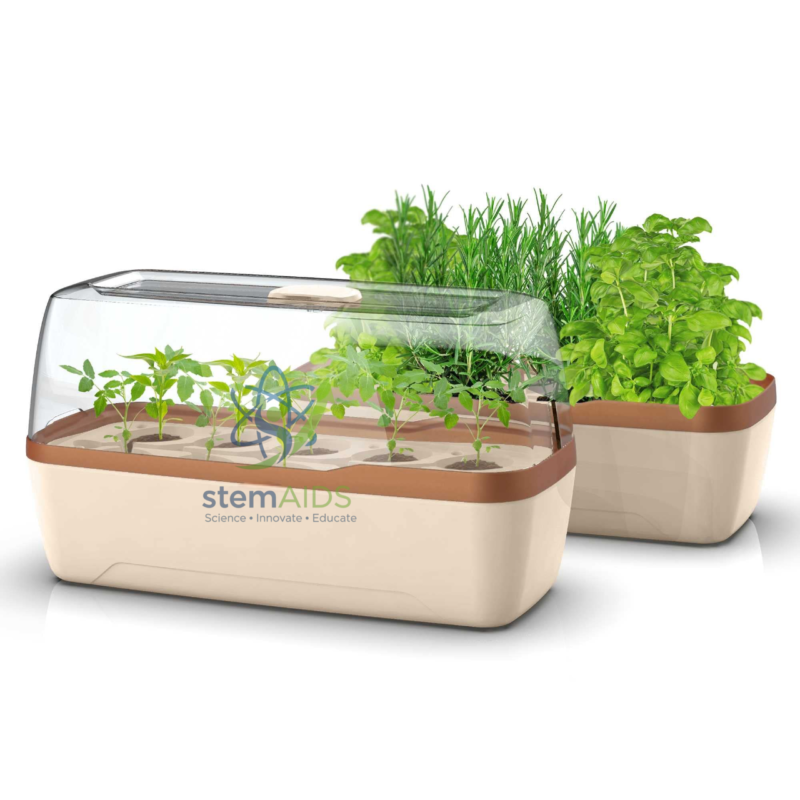
BoQube is the product’s own name, and in the product photo it is a compact unit: a pale planting base with a transparent cover, beside a second unit full of grown herbs. The cover traps moisture and a little warmth, so the air around the seeds stays humid while roots and first leaves form. Once seedlings are established, the cover is lifted for longer spells so the plants adapt to drier room air.
Indoors, light is usually the limiting factor. A bright windowsill that does not get hot midday sun, or a plant grow light, keeps seedlings short and sturdy. Without enough light they stretch towards the window, turn pale and flop over, a response called etiolation that is worth showing a class in its own right. Turning the unit a quarter-turn each day evens out the growth.
The listing does not state the dimensions, the number of planting positions, the growing medium used, or whether the unit has a light or water reservoir, so confirm these before planning a practical. For comparison, a mini greenhouse is a simpler seed tray with a vented lid.
Specifications
| Product name | BoQube indoor greenhouse |
| Design shown in the product photo | Planting base with a transparent cover |
| Use | Germinating seeds and raising seedlings indoors |
| Placement | Bright windowsill out of hot sun, or under a grow light |
| Size, planting positions and accessories | Confirm at enquiry |
Classroom Investigations
- Recording germination day by day and measuring seedling height
- Showing phototropism by lighting seedlings from one side
- Comparing growth in light and dark to demonstrate etiolation
- Growing herbs or salad leaves for lessons on food and plant nutrition
Care & Handling
- Wipe condensation from the inside of the cover every day or two, and ventilate if mould appears on the surface.
- Water gently so the medium stays moist but never waterlogged, since standing water rots seeds.
- Wash the base and cover with warm soapy water between sowings and rinse well, so disease does not carry over to the next crop.
Why Choose LabEquip
Primary classes, science clubs and biology departments without a school greenhouse use an indoor unit like the BoQube to keep plants in view all term. It is listed in LabEquip’s biology lab products; ask about sizes and quantities through the contact page.
Frequently Asked Questions
What does the cover on an indoor greenhouse do?
It keeps humidity high around the seeds and seedlings, so the surface of the growing medium does not dry out and young leaves do not lose water faster than their small roots can supply it.
How much light do seedlings need indoors?
As much bright light as possible without overheating. A sunny windowsill that avoids scorching midday sun usually works; otherwise a grow light run for about 12 to 16 hours a day keeps seedlings compact.
Why are my seedlings tall and thin?
They are stretching for light, which is called etiolation. Move them somewhere brighter or closer to a grow light, turn them daily and lower the temperature a little if the room is very warm.
When should the cover be removed?
Open it for a few hours a day once most seeds have germinated and the first true leaves show, then leave it off for longer each day. This hardening gets seedlings used to drier air before transplanting.
Which seeds are good for a classroom demonstration?
Fast, reliable germinators such as cress, mustard, radish, beans, peas and sunflowers show results within days. Herbs such as basil grow more slowly but can be harvested and used later.
What makes seedlings collapse at soil level?
Usually damping off, a fungal disease favoured by cold, wet compost, still air and dirty containers. Use clean equipment and fresh compost, water sparingly and ventilate by lifting the cover.
Last Updated: September 2026
You must be logged in to post a review.
Bestsellers




Reviews
There are no reviews yet.