



In Stock
Classification of living Organisms
Ensemble classification du vivant features a comprehensive array of modular taxonomic descriptors and organism profiles, allowing for the precise construction of cladograms and Linnaean hierarchies from domain to species levels.
High-Durability Synthetic Matrix Utilizes industrial-grade, UV-stabilized polymer components with high-contrast nomenclature, engineered to withstand high-frequency laboratory usage while maintaining visual clarity and structural integrity during repetitive instructional cycles.
$13.08
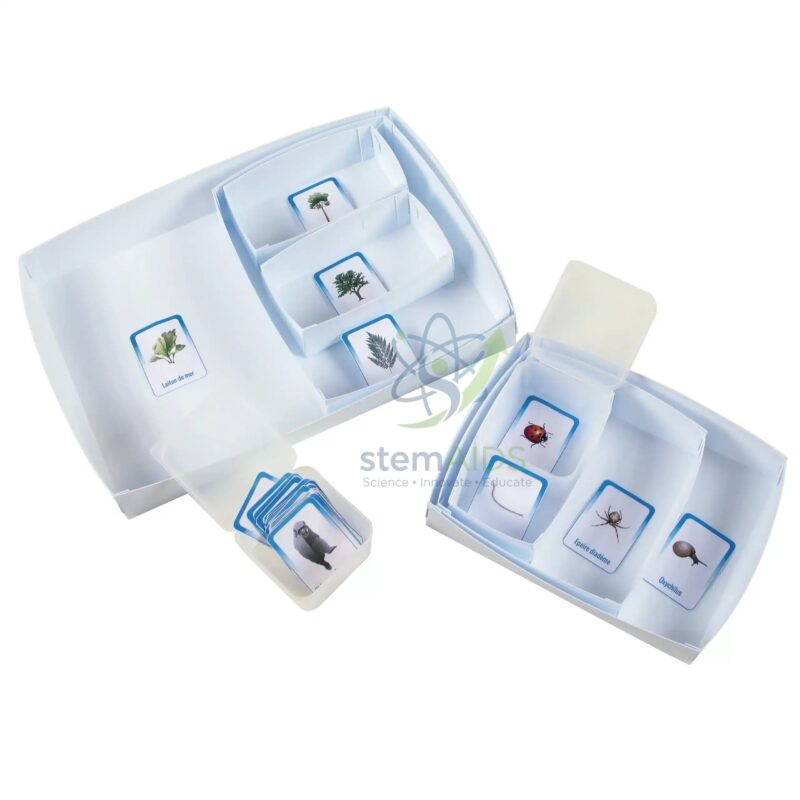
Quick Answer: Classification of Living Organisms is a classroom resource for sorting organisms into groups according to the features they share. The product photo shows compartment trays and picture cards of animals and plants, used to build groups within groups in the way biologists classify life.
Sorting Life into Groups Within Groups
Classification begins with a question students can answer by looking: what features does this organism have? A backbone, four limbs, hair, feathers, a shell, leaves, flowers? Organisms that share a feature go into the same group, and groups that share a broader feature go into a larger group around them. The result is a set of nested boxes, which is how the compartment trays in the product photo appear to be used, with cards placed in smaller compartments inside larger ones.
This nested approach reflects modern classification. Groups are defined by features their members have in common, inherited from a shared ancestor, rather than by what they lack. That is why invertebrates is a handy everyday word but not a true group: it collects animals only by the absence of a backbone. Students discover this for themselves when they look for a feature that every invertebrate card shares and cannot find one.
The listing does not say how many cards or trays are included, which organisms are shown or what age range the resource is aimed at. A classification wall chart gives a printed summary of the same groups for display.
Specifications
| Topic | Classification of living organisms by shared features |
| Format shown in the product photo | Compartment trays with picture cards of organisms |
| Method | Nested grouping: smaller groups placed inside larger ones |
| Level | Primary to lower-secondary life science |
| Number of cards and organisms included | Confirm at enquiry |
Classroom Activities
- Sorting organisms into vertebrates, arthropods, flowering plants and other groups by visible features
- Building a nested classification and comparing it with the class’s first guesses
- Introducing the ranks from kingdom down to genus and species
- Writing simple dichotomous keys from the groups the class has made
Care & Handling
- Return cards to their trays by group at the end of each lesson, and keep a list so missing cards are spotted.
- Wipe the trays with a damp cloth; keep the cards dry and flat so they do not curl.
- Store the resource away from direct sunlight, which fades printed images over time.
Why Choose LabEquip
Primary and middle-school teachers use a hands-on sorting resource so pupils build the classification themselves instead of copying it from a chart. It is part of LabEquip’s biology lab products; ask about the organisms included through the contact page.
Frequently Asked Questions
Why do biologists classify living organisms?
Classification organises the huge variety of life so organisms can be identified, named and compared. Modern classification also reflects evolutionary relationships, so organisms placed together are more closely related to each other than to those in other groups.
What are the main ranks of classification?
From largest to smallest: domain, kingdom, phylum, class, order, family, genus and species. Each species has a two-part scientific name made of its genus and species, such as Homo sapiens.
Why is ‘invertebrates’ not a true group?
It is defined by a feature that animals lack, a backbone, rather than one they share. It includes animals as different as sponges, insects, octopuses and starfish, and starfish are in fact more closely related to vertebrates than to insects.
What is a nested classification?
It is a way of grouping in which each group sits entirely inside a larger one, like boxes within boxes. For example, mammals sit inside the four-limbed vertebrates, which sit inside the vertebrates.
How does classification link to identification keys?
Once organisms are grouped by features, the same features can be turned into yes-or-no questions. Followed in order, those questions form a dichotomous key that leads from an unknown organism to its group or name.
Can the resource be used with real specimens?
Yes. Pupils can add organisms found on a school-grounds survey, placing a drawing or photo in the right compartment, which checks whether they understand the features that define each group.
Last Updated: September 2026
You must be logged in to post a review.
Bestsellers




Reviews
There are no reviews yet.