


In Stock
Chimpanzee Pelvis Skeleton
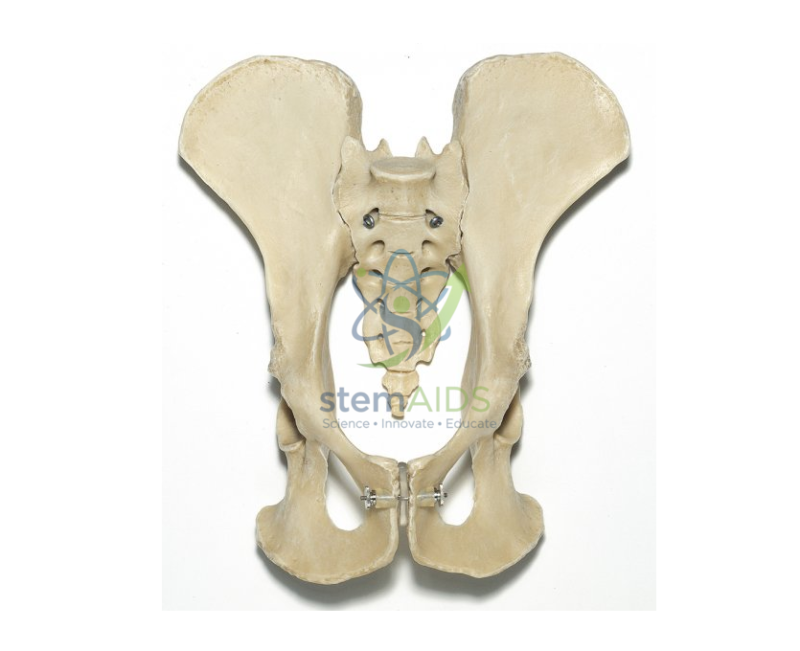
Chimpanzee pelvis skeleton replicates the characteristic elongated, coronally oriented iliac blades and narrow pelvic inlet of Pan troglodytes, essential for analyzing knuckle-walking biomechanics and quadrupedal suspension.
Archival-Grade Osteo-Polymer Casting Fabricated using high-density, non-reactive synthetic resins that preserve trabecular surface textures and specific muscle attachment sites, ensuring dimensional stability for high-precision pelvic measurements.
$187.27
Quick Answer: The Chimpanzee Pelvis Skeleton is a chimpanzee pelvis, the two hip bones and the sacrum joined as in life, used in biology and anthropology to compare an ape’s pelvis with a human one. The contrast in shape is one of the clearest skeletal signs of the change to walking upright.
What the Chimpanzee Pelvis Reveals About Walking
The product photo shows the pelvis from the front: two tall, flat iliac blades rising high on either side of a narrow sacrum, with the hip bones joined at the front by a wire at the pubic symphysis. In a chimpanzee the iliac blades are long and face mostly backward, the ischium below the hip socket is long, and the whole pelvis looks tall and narrow from the front.
A human pelvis is short, broad and bowl-shaped. Its iliac blades are short and curve around to the sides, which places the gluteus medius and minimus at the side of the hip, where they act as abductors: each time a person stands on one leg while walking, these muscles stop the pelvis dropping on the other side. A chimpanzee lacks this arrangement, so when it walks upright it rolls its body from side to side. Its long ischium instead gives the hamstrings good leverage for climbing and for powerful extension of the hip on all fours.
The pelvis is also part of the story of human birth. In humans the birth canal is only a little larger than the baby’s head, which has to turn as it passes through, while in chimpanzees the canal is roomy compared with the newborn’s head. For the skull of the same species see the adult chimpanzee skull, and for a human comparison the Female Pelvic Skeleton. The listing does not state the material, the size or the sex of the individual represented.
Evolution and Anatomy Lessons
- Comparing ape and human pelvis shape in evolution lessons
- Explaining how the gluteal muscles steady the human pelvis during walking
- Discussing fossil pelvises of early hominins and what they reveal about bipedalism
- Linking pelvis shape to childbirth in humans and apes
Specifications
| Specimen | Chimpanzee pelvis: two hip bones and sacrum |
| View in the product photo | Front view, hip bones joined by wire at the pubic symphysis |
| Features to compare | Tall, narrow iliac blades, long ischium, narrow sacrum |
| Subjects | Comparative anatomy, human evolution, primatology |
| Material, size and sex represented | Confirm at enquiry |
Care & Handling
- Lift the chimpanzee pelvis with both hands under the sacrum and hip bones rather than by one iliac blade, which acts as a lever on the joints.
- Check the wire at the pubic symphysis from time to time and avoid twisting the two halves against each other.
- Dust with a soft brush and store it on a padded shelf.
Why Choose LabEquip
Anthropology and biology departments pair an ape pelvis with a human one because the difference in shape explains upright walking better than a diagram does. LabEquip lists it among biology lab products; for material and size, send a question through the contact page.
Frequently Asked Questions
How does a chimpanzee pelvis differ from a human pelvis?
The chimpanzee pelvis is tall and narrow, with long, flat iliac blades facing backward and a long ischium. The human pelvis is short and broad, with iliac blades that curve around to the sides to form a bowl.
Why can humans balance on one leg while walking?
In humans the gluteus medius and minimus attach to the side of the flared ilium and act as abductors. When one foot is lifted, they contract on the standing side to keep the pelvis level. A chimpanzee’s backward-facing blades do not allow this.
What does a long ischium do for a chimpanzee?
It lengthens the lever arm of the hamstring muscles, giving more power to extend the hip. That suits climbing and moving on all fours, where strong hip extension matters more than efficient upright walking.
How is the pelvis used to study human evolution?
Fossil pelvises show whether an early hominin walked upright. A short, broad ilium that flares to the side, as in the famous Lucy skeleton, indicates bipedal walking even when the skull still looks ape-like.
Why is human childbirth harder than in chimpanzees?
The human pelvis is shaped for upright walking, which limits the size of the birth canal, while human babies have large heads. The head must rotate to pass through. In chimpanzees the canal is roomy compared with the newborn’s head.
How should the pelvis be handled in class?
Support it with both hands under the sacrum and hip bones, keep it on a padded surface and avoid pulling the two hip bones apart at the front, where they are joined by wire.
Last Updated: September 2026
You must be logged in to post a review.
Bestsellers





Reviews
There are no reviews yet.