





In Stock
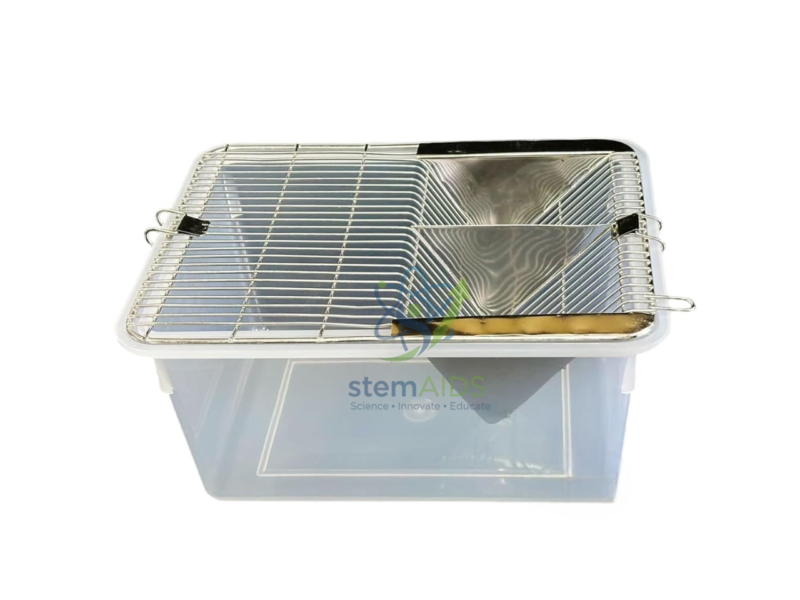
Animal cage (Twin Grill)
Dual-Section SS 304 Grill Assembly: Features a precision-engineered twin-grill lid constructed from medical-grade stainless steel, providing separate, secure compartments for feeding and hydration without compromising overall enclosure security.
Thermally Stable Polymer Housing: Manufactured from high-impact, chemically resistant polypropylene that maintains structural integrity during repeated high-pressure steam sterilization cycles at 121°C, ensuring a pathogen-free environment.
$7.60
Quick Answer: A twin grill animal cage is a tub-style cage for laboratory rodents whose lid is made of two grill sections rather than one. It houses rats or mice on bedding in an animal house, with the grill carrying feed and a water bottle above the animals.
What the Twin Grill Adds
In cages of this style the lid usually has two parts: a hopper section where pellets rest in a V-shaped trough, and a flat section that supports the water bottle, sometimes allowing one part to be opened without lifting the other. Keeping them apart stops pellets falling into the water area and lets staff top up food or change the bottle with less disturbance to the animals. The exact layout and size of this listing can be confirmed with the order.
Compared with the single-grill animal cage, the twin grill suits routines where food and water are handled separately, for example studies that record food intake or give a treatment in drinking water under an approved protocol. Animal houses often standardise on one design so lids and bottles are interchangeable across racks.
The same husbandry rules apply as for any rodent cage: enough floor space for the number and size of animals, clean bedding, fresh water every day, secure lids and a cleaning schedule set by the facility. Work with the animals must be approved by the institution’s animal ethics committee.
Daily and Weekly Care
- Keep the hopper filled so pellets never spill onto the water side.
- Swap water bottles for clean, filled ones rather than topping up old water.
- Clean both grill sections along with the tub at each cage change.
- Make sure both lid sections close securely after every handling.
Specifications
| Type | Rodent cage with two-section (twin) grill lid |
| Lid | Grill sections for feed and water bottle (typical layout) |
| Base | Plastic tub for bedding |
| Size, material and layout | Confirm at enquiry |
| Species | Laboratory rats or mice, depending on size |
Applications
- Housing rats and mice in pharmacy and medical college animal houses
- Studies in which food or water intake is recorded
- Holding animals that receive a treatment in drinking water under an approved protocol
- Breeding pairs or small groups that need frequent feeding checks
Why Choose LabEquip
Animal house managers at pharmacy colleges and research institutes choose twin grill cages when feeding and watering routines must be quick and tidy. LabEquip lists the cage in the Biology Lab Products range; share species and colony size through the contact page.
Frequently Asked Questions
What is a twin grill cage?
It is a rodent cage whose lid is made of two grill sections instead of one piece. In most designs one section forms the feed hopper and the other supports the water bottle, which keeps the two apart. Confirm the layout at enquiry.
How is a twin grill cage different from a standard cage?
A standard cage has a single grill lid carrying both feed and water. The twin grill separates the two functions, which can make feeding, watering and inspection easier without removing the whole lid.
Is the cage suitable for mice as well as rats?
Rats need more floor space and headroom than mice. The cage can house either if its dimensions meet the space guidance for the species and group size, and the grill bars are close enough to stop mice escaping.
How should water bottles be managed?
Fill bottles with clean drinking water, check sipper tubes for blockages or drips every day and replace bottles on a fixed schedule instead of topping them up. Wet bedding under a bottle signals a leak.
How is the cage cleaned?
Move the animals to a clean cage, empty the bedding, wash the tub and both grill sections with detergent, rinse, disinfect and dry. Autoclave where the material allows and the facility requires it.
Why is environmental enrichment recommended?
Nesting material, shelters and gnawing objects let rodents behave more naturally and reduce stress, which improves welfare and can make experimental results more consistent. Many welfare guidelines now expect some enrichment in every cage.
Last Updated: September 2026
You must be logged in to post a review.
Bestsellers




Reviews
There are no reviews yet.