Quick Answer: The Human Taste Organ Model is an anatomy teaching aid representing the tongue, the organ of taste, which biology classes use to explain where taste buds are found and how the sense of taste works.
The Tongue as a Sense Organ
Taste is one of the two chemical senses, and the tongue carries most of its receptors. Lessons with a taste organ model usually begin with the surface of the tongue, which is not smooth but covered in small projections called papillae; taste buds are housed in or around most of them.
Four types of papilla are normally taught. Filiform papillae are the most numerous but carry no taste buds; they give the tongue its rough texture and help move food. Fungiform papillae are scattered over the front and sides, foliate papillae form folds along the back edges, and the large circumvallate papillae make a V-shaped row near the back.
Each taste bud contains receptor cells that respond to five basic tastes: sweet, salty, sour, bitter and umami. Signals travel to the brain along cranial nerves, mainly the facial nerve from the front two-thirds of the tongue and the glossopharyngeal nerve from the back third.
Classroom Uses
- Sense-organ lessons taught alongside the eye, the ear and the skin
- Taste-testing activities in an ordinary classroom, using food-grade solutions and fresh cotton buds
- Explaining why food tastes bland with a blocked nose, linking taste and smell into flavour
- Correcting the old tongue-map idea during revision
Care & Handling
- Keep the taste organ model in a cupboard away from radiators, since strong sun and heat fade coloured surfaces.
- Clean it with a barely damp cloth and dry it straight away, because textured surfaces hold moisture.
- Do not use the model itself in taste tests, and keep food and drink away from it.
- Carry it with both hands and set it down on a flat surface.
Specifications
| Organ represented | Human tongue, the organ of taste |
| Body system | Sensory system: chemical senses |
| Format | Three-dimensional classroom model |
| Typical courses | School biology, nursing and dental assisting introductions |
Why Choose LabEquip
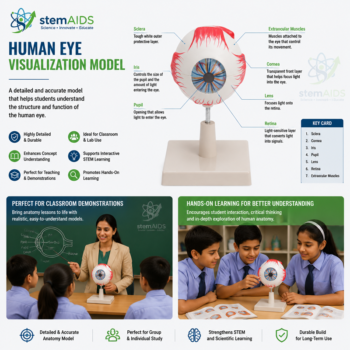
Biology teachers usually buy the Human Taste Organ Model as part of a sense-organ set with the Human Eye Visualization Model and the Small Human Ear Anatomy Model. Class-set requests go through our contact page, and Anatomy Models covers the other body systems for when the unit moves beyond the senses.
Related Products
- Human Tongue Model: An enlarged tongue model for detailed study of its regions, papillae, muscles and nerve supply.
- Human Nose and Olfactory Organ Model: A nose and olfactory organ model, showing the smell pathway that combines with taste to give flavour.
- Lower Jaw Anatomy Model: A lower jaw model for the teeth that work with the tongue during chewing.
- Small Human Ear Anatomy Model: An ear model for continuing the sense-organ unit with hearing and balance.
Frequently Asked Questions
Is the tongue map with separate taste zones correct?
No. The idea that sweet, sour, salty and bitter are each tasted only in one zone of the tongue came from a misreading of an early twentieth-century study. Taste buds able to detect all the basic tastes are found across the tongue, with only small differences in sensitivity between areas. The old map still turns up in some older diagrams, so it is worth correcting during revision.
What are papillae on the tongue?
Papillae are the small projections that give the tongue its rough surface. Filiform papillae are the most numerous but have no taste buds; they help grip and move food. Mushroom-shaped fungiform papillae are scattered over the front and sides, foliate papillae form folds along the back edges, and the large circumvallate papillae make a V-shaped row near the back. The last three carry taste buds.
What are the five basic tastes?
The five basic tastes are sweet, salty, sour, bitter and umami. Umami is the savoury taste of glutamate, found in foods such as tomatoes, cheese and meat broths. Each taste is thought to signal something useful: sugars for energy, salt for minerals, sourness for acidity, bitterness for possible poisons and umami for protein.
Why does food taste bland when you have a cold?
Most of what we call flavour comes from smell rather than taste. When the nose is blocked, aroma molecules from food cannot reach the smell receptors at the top of the nasal cavity, so the tongue detects only the basic tastes and the distinctive flavour is lost. Pinching the nose while tasting different foods shows the effect clearly.
How can students test their sense of taste safely?
Use only food-grade solutions, such as sugar, salt and diluted lemon juice, prepared in clean kitchen containers rather than laboratory glassware, and a fresh cotton bud for every test. Ask about food allergies first, never let students share buds, and have them rinse their mouths with water between tests. The tongue model is then used to discuss the results.
Which nerves carry taste signals to the brain?
Taste from the front two-thirds of the tongue travels in a branch of the facial nerve, the seventh cranial nerve, and taste from the back third in the glossopharyngeal nerve, the ninth. A few taste buds in the throat send signals through the vagus nerve. The signals pass through the brainstem to the taste area of the cerebral cortex.
Last Updated: November 2026