
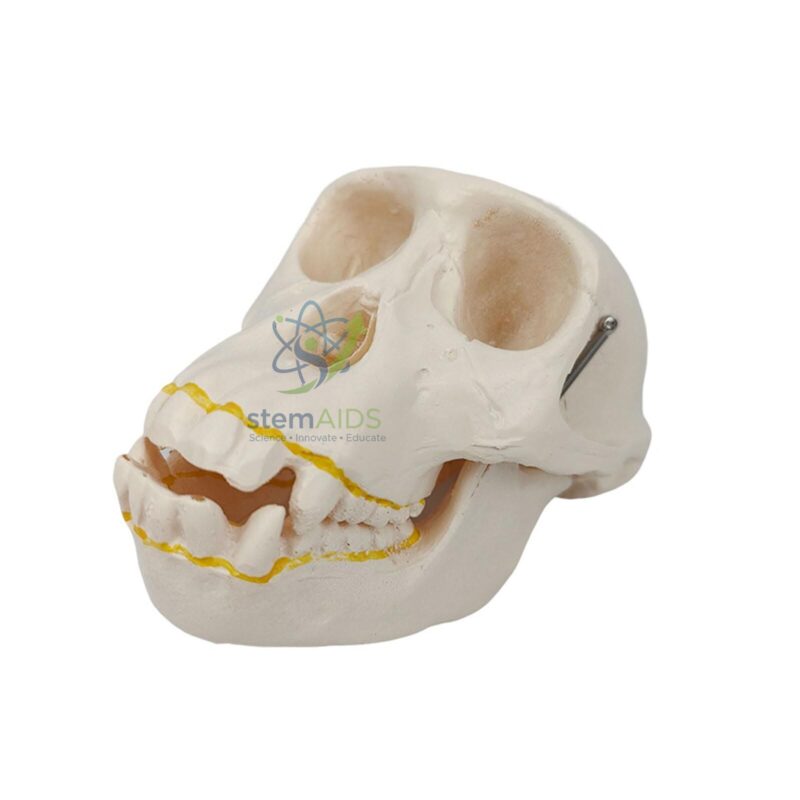
Quick Answer: The Adult Chimpanzee Skull is a teaching skull of an adult chimpanzee, used in biology and anthropology to compare ape and human anatomy. Students examine features such as the brow ridge, projecting jaw, large canines and the position of the foramen magnum to understand human evolution.
Reading a Chimpanzee Skull
Chimpanzees are among humans’ closest living relatives, and their skull shows both what we share and where we differ. It has a heavy brow ridge above the eye sockets, a face that projects forward below them, a relatively small braincase and a long, U-shaped row of teeth, with the rows of cheek teeth running roughly parallel. A human skull has a high, rounded braincase, a flat face tucked beneath it and a curved, parabolic dental arch.
The teeth tell their own story. Adult chimpanzees have large, pointed canines, most prominent in males, with gaps in the opposite jaw, called diastemata, into which they fit when the mouth closes. Human canines are small and barely project. Underneath, the foramen magnum, where the spinal cord leaves the braincase, lies further back in the chimpanzee than in humans, reflecting a spine that meets the skull at an angle rather than from directly below as in an upright biped.
The product photo shows the skull with its lower jaw attached by a spring, so the jaw can be opened to compare the teeth. Placed beside a human skull model, it makes the comparison concrete.
Comparative Anatomy Lessons
- Side-by-side comparison of ape and human skulls in evolution lessons
- Relating the position of the foramen magnum to upright walking
- Comparing dentition and diet across primates
- Anthropology and archaeology courses introducing hominin fossil features
Specifications
| Specimen | Skull of an adult chimpanzee |
| Parts shown in the product photo | Cranium with lower jaw attached by a spring |
| Comparative features | Brow ridge, facial projection, canines and diastemata, foramen magnum, dental arch |
| Subjects | Biology, human evolution, anthropology, comparative anatomy |
Care & Handling
- Hold the skull by the braincase with both hands, never by the jaw, cheekbones or eye sockets, which are the most fragile parts.
- Open the spring-mounted jaw gently and let it close slowly so the spring and hinge are not strained.
- Dust with a soft brush and store it in a padded box or on a shelf where it cannot roll.
Why Choose LabEquip
Biology and anthropology departments use a chimpanzee skull alongside a human one because comparing real proportions teaches evolution better than a list of differences. The skull is in LabEquip’s biology lab products; to confirm material and size, use the contact page.
Related Products
- Human Skull Model: An adult human skull model for comparing the brow, face, dental arch and the position of the foramen magnum with the chimpanzee.
- Chimpanzee Pelvis Skeleton: A chimpanzee pelvis that continues the ape-and-human comparison below the neck, with its tall, narrow iliac blades.
- Cro Magnon Skull Eco: An early modern human (Cro-Magnon) skull, adding a Homo sapiens fossil form to a human-evolution lesson.
- Human Vertebral Column Model With Skull: A human vertebral column with skull that shows how the skull sits on the spine at the atlanto-occipital joint.
Frequently Asked Questions
How is a chimpanzee skull different from a human skull?
A chimpanzee skull has a heavy brow ridge, a face that juts forward below the eyes, a low braincase and a long U-shaped row of teeth with large canines. A human skull has a high, rounded vault, a flat face tucked under the forehead, small canines and a curved dental arch. Set beside a human skull, this chimpanzee skull lets students point to each of these contrasts.
What does the position of the foramen magnum say about walking upright?
The foramen magnum is the opening where the spinal cord leaves the skull. In an upright biped it lies underneath the skull, so the head balances on top of a vertical spine; in a chimpanzee it sits further back, matching a spine that meets the skull at an angle. Comparing its position on the two skulls is a standard human-evolution exercise.
Why are there gaps between the teeth in a chimpanzee jaw?
The gaps, called diastemata, give room for the large canines of the opposite jaw when the mouth closes. Humans have small canines and no such gaps. On this skull the lower jaw is attached by a spring, so it can be opened and shut to show how the upper and lower canines slide past each other.
Are humans descended from chimpanzees?
No. Humans and chimpanzees share a common ancestor that lived millions of years ago, and both lines have evolved separately since they split. A chimpanzee skull is studied as the anatomy of a close living relative, while fossil hominin skulls are used to show the stages in the human line itself.
How does a chimpanzee’s braincase compare in size with a human’s?
The human braincase holds roughly three times the volume of a chimpanzee’s. In the chimpanzee skull the face is large compared with the small, low cranium behind it, whereas in humans the rounded cranium dominates and the face sits beneath it. Students can see this change in proportions at a glance on the adult chimpanzee skull.
How should a teaching skull with a spring-hinged jaw be handled?
Lift the skull with both hands under the cranium and never by the lower jaw, because pulling on the jaw stretches the spring that holds it. Open the jaw gently to show the teeth, dust the skull with a soft brush, wipe it only with a barely damp cloth, and keep it away from the edge of the bench between lessons.
Last Updated: November 2026




Reviews
There are no reviews yet.