
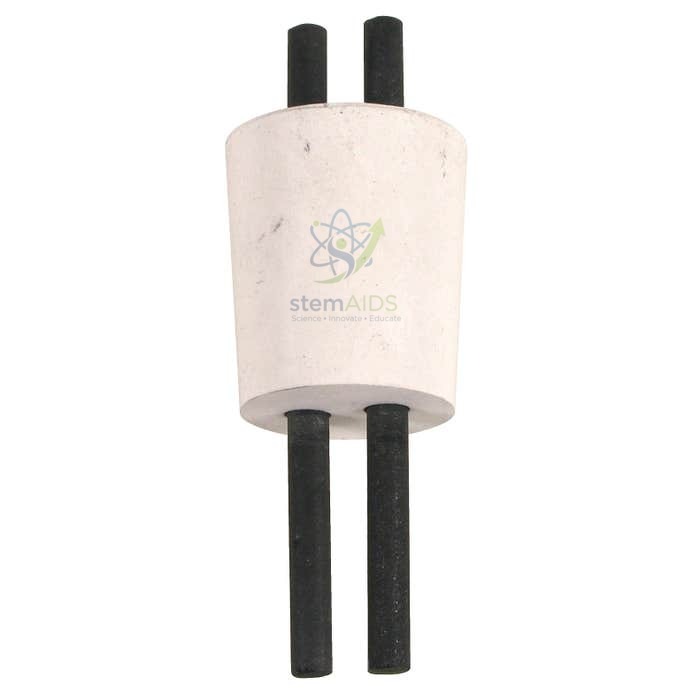
Quick Answer: These graphite carbon electrodes are two black graphite rods passing side by side through a white stopper, as pictured, so that both electrodes can be fitted into a tube or cell in one movement. Graphite electrodes conduct electricity but take little part in most reactions, which makes them the standard inert choice for electrolysing solutions in school labs.
Why Graphite Is Used for Electrodes
Graphite is carbon arranged in stacked sheets of hexagons. Each carbon uses three of its outer electrons to bond within its sheet, and the fourth is delocalised, able to drift across the sheet. Those mobile electrons let graphite conduct like a metal, while the carbon itself is unreactive towards most salts, acids and alkalis. In electrolysis this means the products come from the electrolyte, not from the electrode wearing away.
Graphite also withstands chlorine, which attacks most metal electrodes, so chloride solutions such as brine and copper(II) chloride can be electrolysed without the anode dissolving. The one common exception is a graphite anode in an electrolyte that releases oxygen: the freshly formed oxygen slowly oxidises the carbon to carbon dioxide, so such electrodes thin over time.
The Stopper Mounting
Mounting both rods in one stopper fixes their spacing and keeps them parallel, and the stopper closes the vessel at the same time. With the rods pushed into a tube or a cell of electrolyte and the upper ends connected to a low-voltage DC supply, students can watch products form at each rod and test them without disturbing the set-up.
Specifications
| Product | Graphite (carbon) electrodes, pair |
| Shown in photograph | Two graphite rods through a white stopper |
| Behaviour | Conducting and largely inert in aqueous electrolysis |
| Power | Low-voltage DC laboratory supply |
| Used with | Electrolysis tubes and cells, leads with clips |
| Stopper size and rod length | Confirm at enquiry |
Electrolysis Experiments
- Electrolysing copper(II) chloride to deposit copper and release chlorine
- Electrolysing dilute sulfuric acid or sodium sulfate to produce hydrogen and oxygen
- Electrolysing potassium iodide to show iodine forming at the anode
- Testing whether solutions conduct, using the rods as a simple probe with a bulb in series
Care & Handling
- Rinse the rods with water after use and let the stopper dry before storage
- Clean deposits such as copper from the cathode by gentle rubbing, not by bending the rods
- Handle the rods carefully, since graphite is brittle and can snap if levered
- Keep chloride electrolyses short and well ventilated
Why Choose LabEquip
Teachers choose stopper-mounted graphite rods because the pair goes in and out of a vessel as one unit with fixed spacing. LabEquip supplies them with the U-tube electrolysis apparatus, separate carbon electrodes and other physics lab equipment; contact LabEquip to check stopper size.
Frequently Asked Questions
Why does graphite conduct electricity?
Each carbon atom in graphite uses three electrons to bond within its layer, leaving one electron free to move along the layer. These mobile electrons carry the current.
Do graphite electrodes react during electrolysis?
Usually not, which is why they are called inert. The exception is an anode where oxygen forms, which slowly oxidises the carbon to carbon dioxide.
Can graphite be used to electrolyse brine?
Yes. Graphite resists chlorine, so it is a suitable anode for chloride solutions where metal anodes would be attacked.
Why are the two rods mounted in one stopper?
The stopper keeps the rods parallel at a fixed spacing and closes the vessel, so the electrodes can be fitted and removed in one step.
How are copper deposits removed from the cathode?
Rub gently with a paper towel or fine abrasive paper and rinse. Avoid levering the rod, since graphite is brittle.
When should the electrodes be replaced?
Replace them when a rod becomes thin, crumbly or cracked, which happens slowly at an anode where oxygen is released.
Last Updated: October 2026




Reviews
There are no reviews yet.