
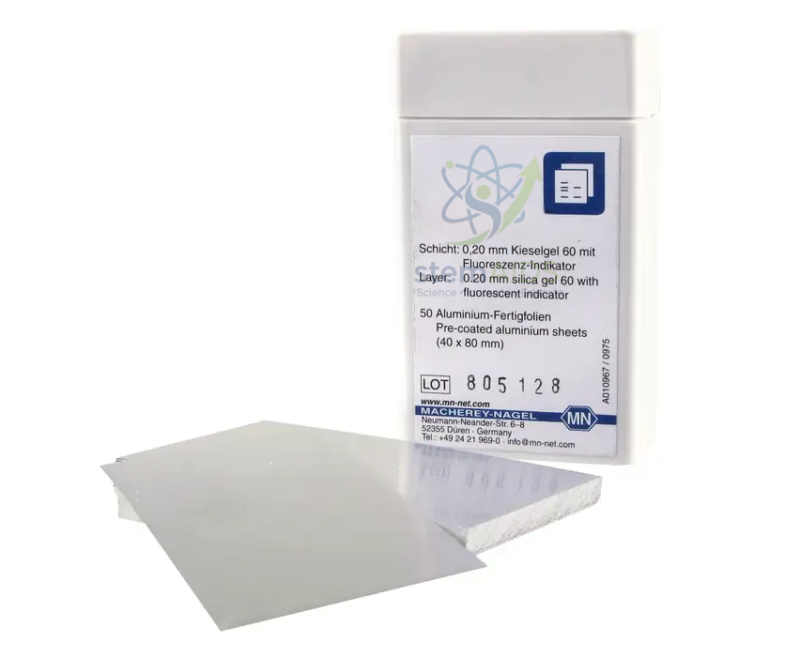
Quick Answer: These thin layer chromatography (TLC) plates are sheets coated with a thin, even layer of silica gel on an aluminium backing, with a fluorescent indicator in the layer, as shown on the pictured pack. TLC plates separate the components of a small sample so they can be compared, identified by their Rf values and checked for purity.
How Thin Layer Chromatography Separates a Mixture
In thin layer chromatography the silica gel coating is the stationary phase and a solvent, the mobile phase, climbs up through it by capillary action. Silica gel is polar, so components that are attracted strongly to it move slowly, while less polar components spend more time in the solvent and travel further. A mixture spotted near the bottom of a plate therefore spreads into separate spots as the solvent rises.
Each spot is described by its Rf value: the distance it moved from the baseline divided by the distance the solvent front moved. Under the same conditions a given compound gives the same Rf, so running an unknown beside known reference samples on one plate is a quick way to identify it.
Why Aluminium-Backed Plates With an Indicator
The aluminium backing pictured is thin enough to cut with scissors, so one sheet can be divided into several narrow plates for a class. Many organic compounds are colourless, and this is where the fluorescent indicator helps: under a short-wave ultraviolet lamp the layer glows, and spots that absorb the light show up as dark patches that can be ringed in pencil. Iodine vapour or a chemical stain can be used as well for compounds that do not show under UV.
Specifications
| Product | Thin layer chromatography plates |
| Layer shown on pack | Silica gel with fluorescent indicator |
| Backing shown | Aluminium sheet, can be cut to size |
| Visualisation | Short-wave UV lamp, iodine vapour or stains |
| Used with | TLC development tank, capillary spotters, solvent, pencil and ruler |
| Sheet size and number per pack | Confirm at enquiry |
Typical TLC Practicals
- Separating the dyes in felt-tip inks or food colourings and comparing Rf values
- Checking the purity of a product made in an organic synthesis practical
- Following the progress of a reaction by spotting samples taken over time
- Separating plant pigments extracted from leaves
Care & Handling
- Handle plates by the edges; skin oils and fingerprints show up as spots
- Mark the baseline and spots in soft pencil only, never in ink
- Store plates flat in their pack, away from solvent vapours and humidity
- Dry developed plates in a fume cupboard before viewing, and use UV-protective eyewear with the lamp
Why Choose LabEquip
Schools and colleges buy TLC plates because one pack supports many quick separations that teach polarity and identification. LabEquip supplies them with the matching TLC development tank and other physics lab equipment; contact LabEquip to confirm the plate size you need.
Frequently Asked Questions
What is the difference between TLC and paper chromatography?
TLC uses a thin layer of silica gel on a backing as the stationary phase, while paper chromatography uses cellulose paper. TLC usually runs faster, gives sharper spots and suits organic solvents.
How is the Rf value calculated?
Measure from the baseline to the centre of the spot and from the baseline to the solvent front. Divide the spot distance by the solvent-front distance. The answer always lies between 0 and 1.
Why must the baseline be above the solvent level?
If the solvent touches the spots directly, the sample dissolves into the solvent pool instead of travelling up the plate, and the separation is lost.
How are colourless spots seen?
Place the dried plate under a short-wave UV lamp. The fluorescent indicator glows and the compounds appear as dark spots. Iodine vapour or a stain can also reveal them.
Can the plates be cut into smaller pieces?
Yes. Aluminium-backed plates can be cut with clean, sharp scissors. Cut cleanly and avoid touching the coated face so the layer does not flake.
Should plates be activated before use?
Silica gel absorbs moisture from the air, which can change Rf values. Plates stored in a humid room can be warmed gently to dry them before use, following the instructions on the pack.
Last Updated: October 2026




Reviews
There are no reviews yet.