
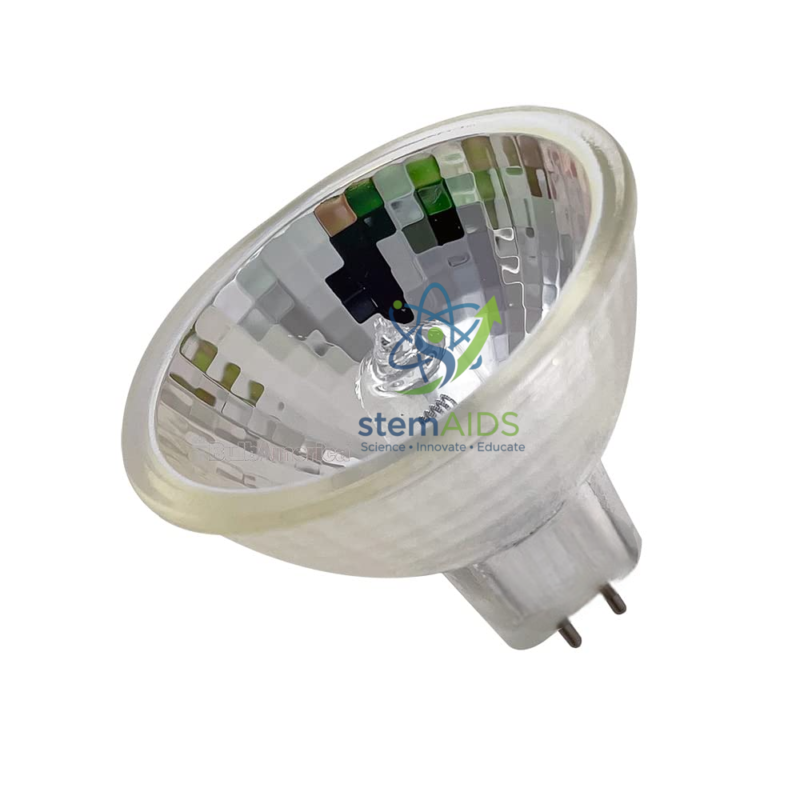
Quick Answer: These 12V halogen bulbs are low-voltage tungsten-halogen lamps for the 12 V named in their title; the photograph shows a reflector-type bulb with a two-pin base. 12V halogen bulbs give bright white light with a continuous spectrum, used in optical benches, projection set-ups and lamp-characteristic experiments.
The Halogen Cycle
Inside a halogen bulb, a tungsten filament runs in a small envelope filled with inert gas plus a trace of a halogen such as iodine or bromine. Tungsten evaporating from the hot filament combines with the halogen near the wall and is carried back to the filament, where it is redeposited. That cycle keeps the envelope clear and lets the filament run hotter than in an ordinary bulb, giving whiter light.
The cycle needs a hot envelope, which is why it is made of quartz or hard glass and why the bulb runs very hot. Fingerprints left on the glass can create hot spots that weaken it, so the bulb is handled by its base or with a clean cloth.
Experiments With a 12 V Halogen Source
Seen through a prism or diffraction grating, the light from 12V halogen bulbs forms an unbroken spectrum from red to violet, the signature of a hot solid, in contrast with the bright lines of a discharge lamp and the peaked spectrum of a white LED. That makes the bulb a reference source for spectrum lessons and a good light for colour-filter and absorption work.
The filament is also a classic non-ohmic conductor. Raising the voltage in steps and recording the current gives a curve that bends over, because the resistance of tungsten rises sharply as it heats. The cold resistance measured with a meter is many times smaller than the resistance worked out at 12 V.
Applications
- Light source on optical benches and in projection experiments
- Showing a continuous spectrum with a prism or diffraction grating
- Plotting the current-voltage curve of a filament lamp
- Lighting for colour-filter and light-absorption demonstrations
Care & Handling
- Handle by the base or with a clean cloth, never touching the glass with bare fingers
- Let the bulb cool fully before removing it
- Use a 12 V supply able to deliver the bulb’s current, and never exceed 12 V
- Keep the lit bulb away from flammable materials
Specifications
| Product | Halogen bulbs (tungsten-halogen lamps) |
| Voltage, from title | 12 V |
| Shown in photograph | Reflector bulb with a two-pin base |
| Light | Bright white light with a continuous spectrum |
| Holder | A two-pin lamp holder that matches the base |
| Wattage, base type and bulbs per order | Confirm at enquiry |
Why Choose LabEquip
Physics teachers replacing lamps in optical benches and light boxes keep 12V halogen bulbs on hand, because a failed lamp stops a whole optics practical. For a cooler, mains-powered source see the 10W LED floodlight; contact LabEquip with the base and wattage of your existing lamps, or browse our physics lab equipment.
Frequently Asked Questions
Why should halogen bulbs not be touched with bare fingers?
Skin oils left on the hot glass can cause local overheating and weaken the envelope, shortening the bulb’s life. Handle it by the base or with a clean cloth.
What is the halogen cycle?
Tungsten evaporated from the filament combines with the halogen gas near the hot wall and is carried back to the filament. This keeps the glass clear and allows a hotter, whiter filament.
Why does the filament’s resistance change with voltage?
The resistance of tungsten rises as it gets hotter. At 12 V the filament is far hotter than at low voltage, so its resistance is many times its cold value and the current-voltage graph curves.
What kind of spectrum does a halogen bulb give?
A continuous spectrum, from red to violet without gaps, because the light comes from a hot solid filament. Discharge lamps give separate bright lines instead.
Can the bulb be run from a 12 V AC supply?
A filament heats equally on AC or DC of the same effective voltage, so a 12 V AC or DC supply can be used, provided it can deliver the current the bulb needs.
Which wattage and base are these bulbs?
The listing gives the 12 V rating, and the photograph shows a reflector bulb with two pins. The wattage, base type and number per order can be confirmed at enquiry.
Last Updated: October 2026




Reviews
There are no reviews yet.