
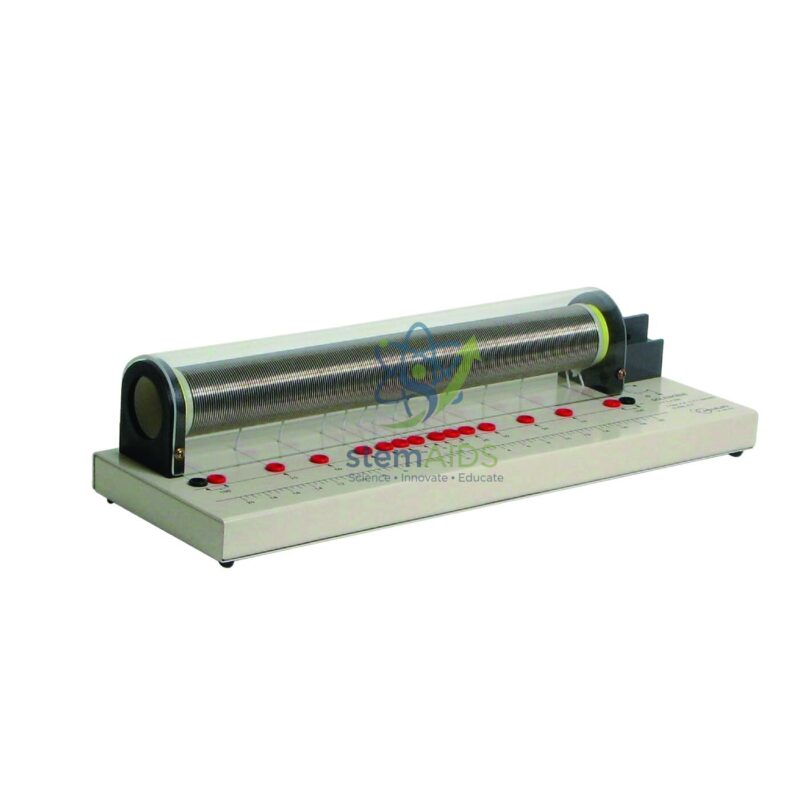
Quick Answer: The Protected Solenoid is a long coil of wire enclosed in a clear protective tube and mounted on a base with terminal sockets. It is used to measure the nearly uniform magnetic field inside a solenoid and to show that the field depends on the current and the number of turns per unit length, B = μ₀nI.
The Field Inside a Long Solenoid
A long, closely wound coil produces a magnetic field that is strong and nearly uniform inside and weak outside. Well away from the ends, the field depends only on the current I and the number of turns per metre n: B = μ₀nI. The radius of the coil does not appear in the formula, which surprises many students.
At each end the field drops to about half its central value, because a point at the end has coil on one side only. Mapping the field along the axis with a probe shows a flat central plateau falling away at each end.
Why the Coil Is Protected
In the protected solenoid the winding sits inside a transparent tube, so the turns are visible but cannot be scratched, pulled or knocked loose. The tube also keeps fingers off the wire, which warms when current flows for a while. In the product photograph the tube lies along a base with a row of sockets on its front edge and a terminal block at one end, giving a sturdy, bench-ready unit.
Specifications
| Product | Solenoid enclosed in a clear protective tube |
| Mounting | Base with terminal sockets |
| Field inside | Nearly uniform in the central region, B = μ₀nI |
| Measured with | Hall probe and teslameter, or search coil with AC |
| Number of turns and socket tappings | Confirm at enquiry |
Experiments
- Measuring the field at the centre for a range of currents and plotting B against I
- Mapping the field along the axis to show the uniform centre and weaker ends
- Estimating μ₀ from the gradient of B against I
- Inducing a voltage in a search coil placed inside when the solenoid carries AC
Care & Handling
- Keep the current within the rating marked for the solenoid
- Switch off between sets of readings so the winding does not overheat
- Insert probes gently along the axis without forcing them against the tube
- Clean the clear tube with a damp cloth only
Why Choose LabEquip
Advanced-level and college physics practicals on magnetic fields rely on a solenoid with a well-defined winding, and the protective tube keeps that winding intact through years of class use. LabEquip supplies it with the maximum flux coil among its physics equipment; turn and tapping details can be confirmed through the contact page.
Frequently Asked Questions
Why is the field at the ends weaker than in the middle?
At the centre, turns on both sides contribute to the field. At an end, turns lie on one side only, so the field there is about half the central value.
How is the field inside the solenoid measured?
Use a Hall-effect probe on the axis, facing along the field, connected to a teslameter. Alternatively, pass alternating current and measure the voltage induced in a small search coil.
Does the field depend on the solenoid’s diameter?
For a long solenoid, no. The field inside depends only on the number of turns per metre and the current, as long as the solenoid is much longer than it is wide.
What does the protective tube do?
It keeps the winding from being scratched or disturbed, keeps fingers off the warm wire, and leaves the turns visible so students can see what they are measuring.
Can the solenoid be used with alternating current?
Yes, for induction experiments. With AC the coil’s inductance limits the current more as frequency rises, so check the current with a meter and stay within the rating.
How is the permeability of free space found with the solenoid?
Plot the measured field at the centre against current. The gradient equals the permeability of free space times the number of turns per metre, so dividing by turns per metre gives the constant.
Last Updated: October 2026




Reviews
There are no reviews yet.