
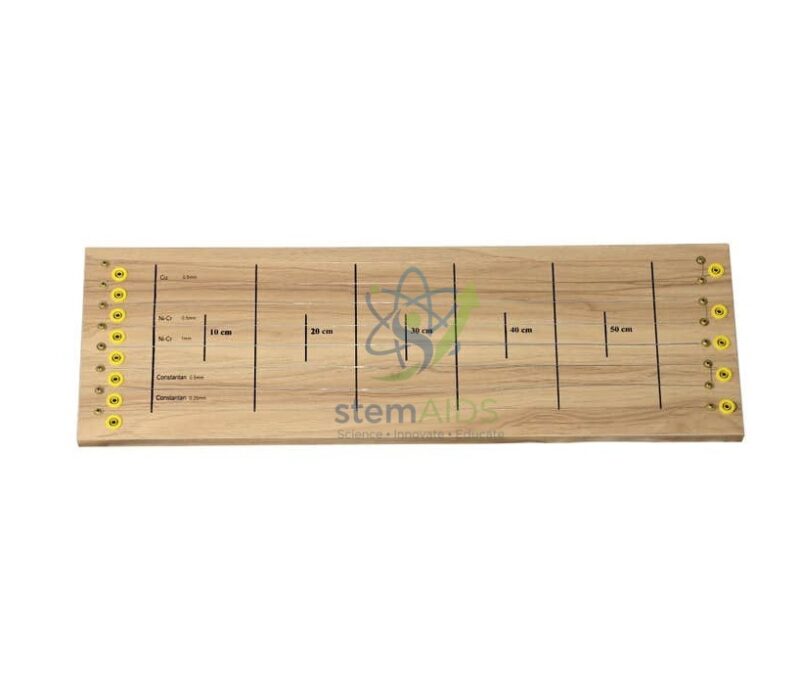
Quick Answer: The electricity transmission model is a wooden board carrying wire conductors stretched between terminal sockets, with their lengths marked, for measuring how a conductor’s resistance depends on its length and relating that to the energy lost in power lines. It turns the idea of line losses into readings students take with a meter.
Resistance of a Wire: R = ρL/A
The electricity transmission model rests on one formula. The resistance of a wire is proportional to its length L, inversely proportional to its cross-sectional area A, and depends on the material through its resistivity ρ. Double the length and the resistance doubles; double the area and it halves.
The board in the product photograph has several conductors running between rows of sockets at each end, with length markings printed beside them, so students can measure resistance for different lengths without cutting or stretching wire themselves.
From Bench Wires to Power Lines
A current I flowing through a line of resistance R wastes power as heat at a rate I²R. Because the loss grows with the square of the current, halving the current cuts the loss to a quarter. That is why grids step the voltage up with transformers before transmission: for the same power, a higher voltage means a smaller current and much smaller losses in the long lines.
Measurements on the board give real values of R for each length, from which students can calculate the heat that would be lost at different currents and see why line length and current both matter.
Applications
- Measuring resistance for several conductor lengths and plotting R against L
- Calculating resistivity from measured resistance, length and wire diameter
- Working out power lost in a line at different currents
- Supporting a lesson on why transmission uses high voltage
Specifications
| Product | Electricity transmission model board |
| Construction | Wire conductors between terminal sockets on a wooden board |
| Markings | Conductor lengths printed on the board |
| Quantity studied | Resistance against length; power lost as I²R |
| Wire material and thicknesses | Confirm at enquiry |
Care & Handling
- Keep currents modest and switch off between readings so the wires stay cool
- Tighten plugs firmly in the sockets; loose contacts add resistance
- Do not bend or pull the stretched conductors
- Store the board flat in a dry place
Why Choose LabEquip
This board gives schools a measurable route into one of the most common exam questions on the National Grid and power transmission. LabEquip supplies it with the larger electricity distribution study model among its physics equipment; wire options can be discussed on the contact page.
Frequently Asked Questions
How does wire length affect resistance?
Resistance is directly proportional to length for a wire of uniform material and thickness. Doubling the length doubles the resistance, because the current has twice as far to travel through the material.
Why do power companies transmit electricity at high voltage?
For a given power, a higher voltage means a smaller current. The heat lost in the lines depends on the current squared, so reducing the current greatly reduces the losses.
How is the resistance of each conductor measured?
Use an ohmmeter across the sockets at each end, or pass a measured current and read the voltage across the conductor, then divide voltage by current. Subtract the resistance of the leads for short lengths.
Why is a short wire’s resistance hard to measure accurately?
Its resistance is small and can be comparable with the resistance of the leads and plug contacts. Measuring the leads alone and subtracting their value improves the result.
What is resistivity?
Resistivity is a property of the material, equal to resistance times cross-sectional area divided by length. It is measured in ohm metres and lets wires of different sizes be compared fairly.
Does the wire heat up during the experiment?
With a steady current it warms a little, and a warmer metal wire has a higher resistance. Keeping currents small and switching off between readings keeps the results consistent.
Last Updated: October 2026




Reviews
There are no reviews yet.