
Quick Answer: Electromechanical Conversions Direct Current Motors is a bench study of DC motor electromechanical conversion: a direct current motor is supplied, loaded and measured so students can link the electrical input to the mechanical output through speed, torque, back EMF and efficiency.
The Equations Behind a DC Motor
Three relations describe the DC motor on this bench. The back EMF generated by the turning armature is proportional to speed, E = kω. The torque produced is proportional to armature current, T = kI, with the same constant k. And the supply voltage is shared between the back EMF and the voltage drop across the armature resistance, V = E + RI.
Multiplying the last equation by current gives the power balance: VI = EI + RI². The electrical input VI splits into EI, which becomes mechanical power, and RI², which heats the windings. Friction then takes a further share before the shaft delivers Tω to the load.
What the Bench Set-Up Shows
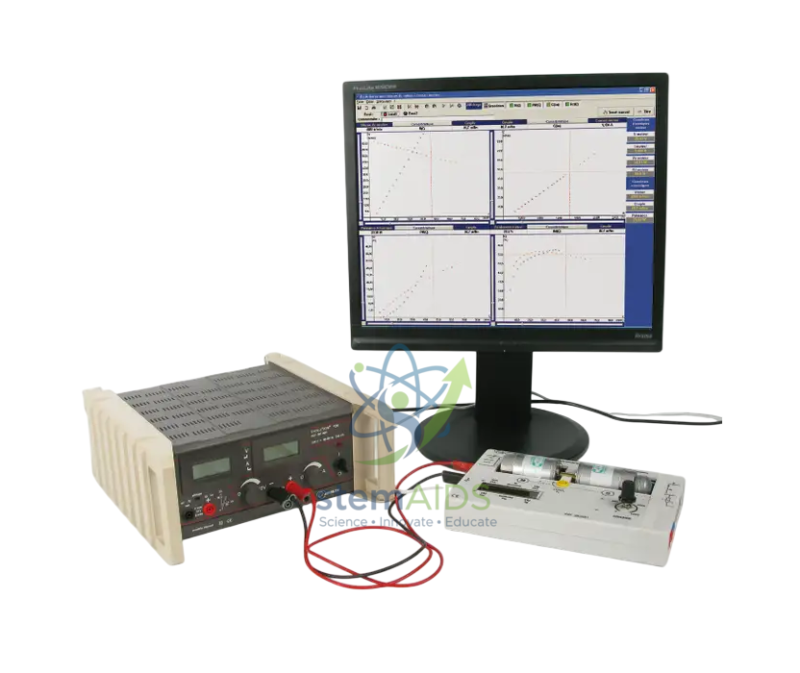
The product photograph shows a supply unit, a motor bench and a computer displaying measured curves, which is the way this study is usually organised: the motor is loaded step by step and speed, current, voltage and torque are recorded at each step. From the points, students plot speed against torque, current against torque and efficiency against load.
The speed-torque graph is close to a straight line falling from no-load speed, while the current climbs as torque rises. Efficiency is low at both extremes, with nothing useful delivered at no load and nothing turning at stall, and reaches a peak at moderate load.
Measurements and Graphs
- Plotting the speed-torque characteristic of a DC motor
- Measuring armature resistance and using it to calculate back EMF at each load
- Finding the load at which efficiency peaks
- Running the machine as a generator and confirming that output voltage is proportional to speed
Specifications
| Study | Electromechanical conversion in direct current motors |
| Quantities | Voltage, current, speed, torque, input and output power, efficiency |
| Arrangement in photograph | Supply unit, motor bench and computer display of curves |
| Results | Characteristic curves of a DC motor under load |
| Items included in the set | Confirm at enquiry |
Care & Handling
- Increase the load gradually and avoid holding the motor stalled at full supply voltage
- Keep guards in place over any coupling or rotating part
- Allow the motor to cool between long series of readings so the winding resistance stays near its starting value
- Switch off the supply before changing any connection
Why Choose LabEquip
Polytechnics, engineering colleges and upper-secondary schools teaching energy conversion buy this kind of DC motor study to give students real characteristic curves. LabEquip supplies it with related items such as a DC joulemeter among its physics equipment; the configuration can be discussed through the contact page.
Frequently Asked Questions
Why does a DC motor’s current rise when it is loaded?
The load slows the motor, so the back EMF falls. A larger share of the supply voltage then appears across the armature resistance, and the current rises until the extra torque it produces balances the load.
What is back EMF and how can students find it?
Back EMF is the voltage the spinning armature generates in opposition to the supply. It can be calculated as the supply voltage minus current times armature resistance, or measured directly by driving the machine at the same speed as a generator with no load.
At what load is a DC motor most efficient?
At a moderate load. With no load the input only covers friction and winding losses, and at stall nothing turns, so both give zero useful output. Efficiency rises from no load, reaches a peak and falls again as the load approaches stall.
Is a computer required for this study?
Not strictly. The photograph shows curves on a computer, which makes collecting many points quick, but the same readings can be taken by hand with meters and a tachometer and plotted on paper.
How is mechanical output power calculated?
Multiply the torque in newton metres by the angular speed in radians per second. Angular speed is two pi times the revolutions per minute divided by sixty.
Can the same DC machine work as a generator?
Yes. A DC machine is reversible: driven mechanically, it generates a voltage proportional to its speed, which is a direct way to show that motor and generator are the same device used in opposite directions.
Last Updated: October 2026






Reviews
There are no reviews yet.