
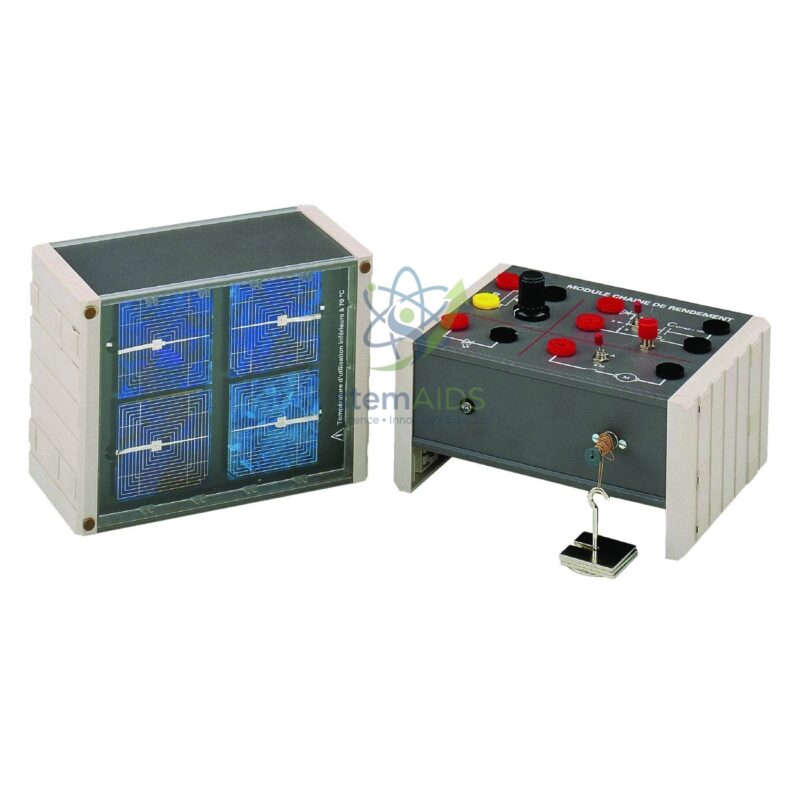
Quick Answer: Energy and Efficiency Models are classroom units for following energy through a conversion chain: students measure the energy that goes in, the useful energy that comes out and the share lost on the way. In the product photograph one unit carries a solar panel and the other a panel of terminal sockets with a small motor that raises a hanging load.
Following Energy Through a Conversion Chain
With the Energy and Efficiency Models, efficiency stops being a definition to memorise and becomes a number students work out from their own readings. Efficiency is the useful energy delivered divided by the energy supplied, usually quoted as a percentage. When a small motor winds a mass upwards, the useful output is the gain in gravitational potential energy, m × g × h, while the electrical input is voltage × current × time.
No real converter reaches 100 percent. The missing energy leaves as heat in the motor windings, friction in bearings and gears, sound, and, for a solar panel, the large part of the incoming light that never becomes electrical energy at all. Seeing a figure such as one fifth or one third at the end of a practical makes the point more firmly than a textbook diagram does.
How an Efficiency Measurement Runs
A lamp at a fixed distance lights the panel, and a voltmeter and ammeter, or a joulemeter, record the electrical power the panel delivers. The motor module then lifts its load through a measured height while a stopwatch records the time. Dividing m × g × h by the electrical energy gives the motor stage efficiency; comparing panel output with lamp power gives a feel for the first stage.
Because each stage passes only part of what it receives to the next, the overall efficiency of a chain is the product of the stage efficiencies. Two stages that each manage one half give one quarter overall, a result that surprises many students and explains why engineers try to keep conversion chains short.
Specifications
| Product | Energy and Efficiency Models: modules for energy input and output measurement |
| Units in the photograph | Solar panel module; socket panel module with small motor and hanging load |
| Quantities measured | Electrical energy in (V × I × t) and useful energy out (m × g × h) |
| Connection | Terminal sockets for laboratory leads |
| Accessories used | Meters or joulemeter, stopwatch, metre rule, lamp, masses |
| Full module list | Confirm at enquiry |
Practicals the Models Support
- Calculating the efficiency of a motor that lifts a load, and repeating it for heavier and lighter loads
- Building a Sankey diagram from measured values rather than from invented numbers
- Comparing the output of the solar panel at different lamp distances and angles
- Showing that the overall efficiency of a chain is the product of the efficiencies of its stages
Care & Handling
- Keep the lamp far enough from the solar panel module that the panel surface does not become hot
- Let the lifted load down gently and keep the cord from tangling on the drum or shaft
- Clean the panel face with a soft dry cloth; dust lowers the output and spoils comparisons
- Store the modules in a dry cupboard with leads unplugged
Why Choose LabEquip
Energy and efficiency are examined in almost every secondary physics course, and these models give students measured numbers to argue from. LabEquip supplies them to schools that want energy practicals rather than paper exercises, alongside the rest of their physics equipment; a DC joulemeter simplifies the input measurement, and the contact page is the place to agree the module list.
Frequently Asked Questions
How is efficiency calculated with these models?
Efficiency is the useful energy out divided by the energy put in, usually written as a percentage. For the motor lifting a load, the useful output is mass times g times height raised, and the electrical input is voltage times current times the time taken.
Why is the measured efficiency always well below 100 percent?
Every conversion wastes some energy. A motor loses energy as heat in its windings and as friction, and a solar panel converts only part of the light reaching it. That waste is the reason the useful output is always smaller than the input.
Can the overall efficiency of a chain be found from its stages?
Yes. Multiply the stage efficiencies together. If the panel passes on one fifth of the lamp energy it receives and the motor turns half of its input into lifting, the chain as a whole manages one tenth.
What extra equipment is needed for the practical?
A voltmeter and ammeter or a joulemeter, a stopwatch, a metre rule for the lift height, a set of masses and a bright lamp for the solar panel. Laboratory leads connect the modules to the meters.
Does the solar panel module work under ordinary classroom lights?
It gives some output, but a bright lamp at a fixed distance gives readings that are larger and repeatable. Keep the distance and angle the same whenever two results are to be compared, because panel output changes strongly with both.
Which modules come in the set?
The photographed set shows a solar panel unit and a motor unit with a hanging load. The full module list can be confirmed when you enquire, and it helps to say which energy conversions your syllabus asks students to measure.
Last Updated: October 2026




Reviews
There are no reviews yet.