
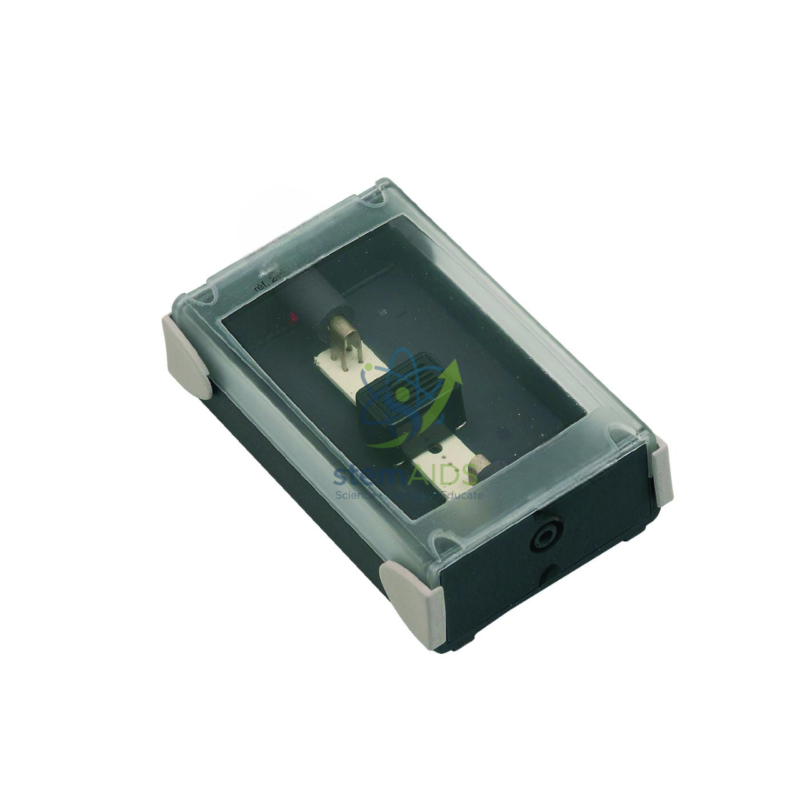
Quick Answer: This is a buzzer on support: a small electrical sounder fixed to a base with connecting terminals so it can be wired into bench circuits as an audible indicator. Students use the buzzer on support to hear when a circuit is complete, to build simple alarms and continuity testers, and to compare sound and light as signals.
A Sounder Built for the Bench
Loose buzzers have thin flying leads that snap after repeated bending and are fiddly to grip with crocodile clips. Mounting the buzzer on a support with proper terminals solves both problems: the sounder sits upright, the leads connect firmly and the polarity marks stay in view. That makes the mounted version suitable for class sets that different groups take apart and rebuild every lesson.
Most small buzzers are polarised direct-current devices with their own drive circuit inside, so they sound only when the positive terminal goes to the positive side of the supply. The sounding element may be electromagnetic or piezoelectric; the element type, voltage range and terminal style of this module should be confirmed before ordering so that it matches the sources and leads already in the lab.
Circuits to Build With It
- A continuity tester: cell, buzzer and two probe leads, sounding when the probes touch a conductor
- A door or intruder alarm using a push switch or pressure pad to complete the circuit
- A light-operated alarm in which a light dependent resistor and transistor switch the buzzer
- Morse code practice with a key or student switch in series with the buzzer
Buzzer, Bell or Lamp?
A lamp shows current by glowing and a bell rings with a hammer striking a gong, but a buzzer is smaller, quieter and draws little current, so it can stay in a circuit for long periods. It responds to a pulse instantly, which helps when students need to hear short signals or when their eyes are on a meter and a visual indicator would be missed. For a signal that must carry across a whole room, an electric bell is the louder choice.
Specifications
| Component | Electrical buzzer (sounder) |
| Mounting | On a support with connection terminals |
| Supply | Direct current; observe polarity |
| Use | Audible indicator in student circuits |
| Element type, voltage range and terminals | Confirm at enquiry |
Care & Handling
- Connect the buzzer on support with the correct polarity; reversed, a polarised buzzer stays silent.
- Keep the sound opening free of dust and never push objects into it.
- Do not hold the buzzer close to the ear while it sounds, and avoid long continuous sounding in a small room.
- Store with the terminal screws tightened down so they are not lost.
Why Choose LabEquip
LabEquip supplies mounted buzzers in class quantities for schools that run circuit practicals with several groups at once, together with switches, lamp holders and sources from our physics lab equipment range. Ask us through the contact page about the voltage range and terminal type that will suit your existing leads.
Frequently Asked Questions
Why does the buzzer not sound when it is connected?
Most small buzzers are polarised, so first check that the positive terminal goes to the positive side of the supply. Then check that the supply voltage is within the buzzer’s range and that every connection is tight. A buzzer in series with a large resistance may also receive too little current to sound.
Is the buzzer electromagnetic or piezoelectric?
Both kinds are sold mounted on supports. An electromagnetic buzzer uses a small coil to vibrate a metal diaphragm, while a piezoelectric one uses a ceramic disc that flexes when driven. Either works as an indicator; the element fitted to this module should be confirmed at enquiry.
How do I make a continuity tester with it?
Connect a cell, the buzzer and two test leads in series, leaving the free ends of the leads as probes. Touching the probes together completes the circuit and the buzzer sounds. Touching them across a wire, fuse or switch shows whether that part conducts; across plastic or wood it stays silent.
What is the difference between a buzzer and a bell?
A bell uses an electromagnet to swing a hammer against a gong and keeps ringing through a make-and-break contact. A buzzer has no hammer; a small diaphragm vibrates rapidly to give a higher, quieter tone. Buzzers draw less current and fit more easily into small circuits.
Can the buzzer be connected in parallel with a lamp?
Yes. In parallel each component receives the full supply voltage, so both work, and removing one does not stop the other. In series they share the voltage, and the buzzer may sound weakly or not at all if the lamp takes most of it.
Is the sound level suitable for a classroom?
Small indicator buzzers are designed as signals rather than building alarms, but any buzzer held next to the ear is unpleasant. Keep it on the bench, sound it only as long as needed and switch circuits off between tests.
Last Updated: October 2026




Reviews
There are no reviews yet.