
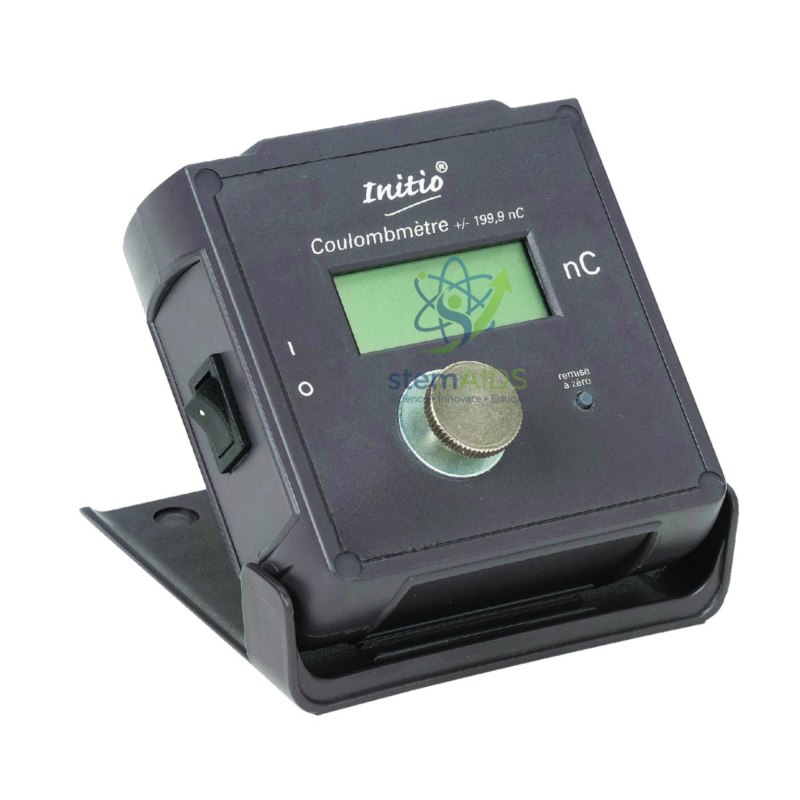
Quick Answer: The Coulombmeter Initio is a digital instrument that measures electric charge, showing both its size and its sign, so electrostatics moves from detecting charge to measuring how much there is. As pictured, it has a display, a power switch, a charge input on the front and a fold-out stand.
How a Charge Meter Works
A charge meter of this kind contains a capacitor of known, relatively large capacitance connected to its input. When a charged object touches the input, nearly all of its charge flows onto that internal capacitor, because the capacitor’s capacitance is far larger than the object’s. The meter measures the small voltage across the capacitor with a very high input resistance amplifier and displays the charge using Q = CV.
That design explains the main rules of use. The meter must be zeroed before each measurement so that leftover charge on the internal capacitor is not counted, and readings should be taken promptly, because charge slowly leaks away through the insulation. The common terminal should be connected to earth, or held by the experimenter, so that the measurement has a stable reference.
Experiments That Become Quantitative
With the meter, students can measure the charge on a rubbed rod and see how it varies with the number of strokes or the cloth used. Placing a rubbed rod and its rubbing cloth together inside a metal can connected to the input, a Faraday pail, gives a reading close to zero, showing that rubbing separates charge rather than creating it. Charging a capacitor from a known voltage and then discharging it into the meter checks Q = CV directly, and repeating at several voltages gives a straight-line graph whose gradient is the capacitance.
Specifications
| Instrument | Digital coulombmeter (charge meter) |
| Quantity measured | Electric charge, with sign |
| Controls | Power switch and zeroing control, as pictured |
| Mounting | Fold-out stand for bench use, as pictured |
| Range, resolution and power source | Confirm at enquiry |
Typical Uses
- Measuring charge produced by friction between different rods and cloths
- Showing conservation of charge with a rod and cloth placed together in a Faraday pail
- Verifying Q = CV for a capacitor charged from a known voltage
- Measuring how charge is shared between two identical conducting spheres
Care & Handling
- Zero the meter before every reading and keep the input lead short and away from clothing.
- Never connect the input to a mains circuit or directly to a high-voltage generator terminal; transfer charge with a proof plane or small sphere instead.
- Keep the input socket and lead insulation clean and dry, since moisture makes the reading drift.
- Switch the meter off after use and follow its instructions on the power source before long storage.
Why Choose LabEquip
Charge meters are chosen by teachers who want electrostatics to produce numbers that students can graph and analyse, from upper secondary practicals to first-year university work. LabEquip supplies the meter with related items such as the needle electroscope for qualitative checks and other physics lab equipment; send your quantities through the contact page.
Frequently Asked Questions
What is the difference between a coulombmeter and an electroscope?
An electroscope shows that charge is present and roughly how large it is, but gives no number. The charge meter measures the actual charge, normally in nanocoulombs, and shows whether it is positive or negative.
Why must the meter be zeroed before each measurement?
Some charge can remain on the internal capacitor from the previous measurement or from handling the lead. Zeroing clears it, so the display shows only the charge delivered in the new measurement.
How do I measure the charge on a rubbed rod?
Zero the meter, connect a small metal can to the input and lower the rubbed rod into the can without touching it. The can acquires an induced charge equal to the rod’s, so the reading is more complete than touching an insulating rod on the input, which only gives up charge where it makes contact.
Why does the reading drift slowly?
Charge leaks away through the insulation of the input, the lead and the air, and leakage is faster in humid conditions. Read the display promptly after the charge is delivered and keep the input dry and clean.
Can the meter measure the charge stored on a capacitor?
Yes, provided the charge is within the meter’s range. Charge the capacitor from a known voltage, disconnect it, then connect it across the input; the reading is the stored charge, which can be compared with capacitance multiplied by voltage.
Is the meter suitable for a Van de Graaff dome?
Not directly, because the dome holds far more charge at a far higher voltage than the meter is designed for. Sample the dome with a small proof plane or metal sphere on an insulating handle and measure the charge it carries away instead.
Last Updated: October 2026






Reviews
There are no reviews yet.