
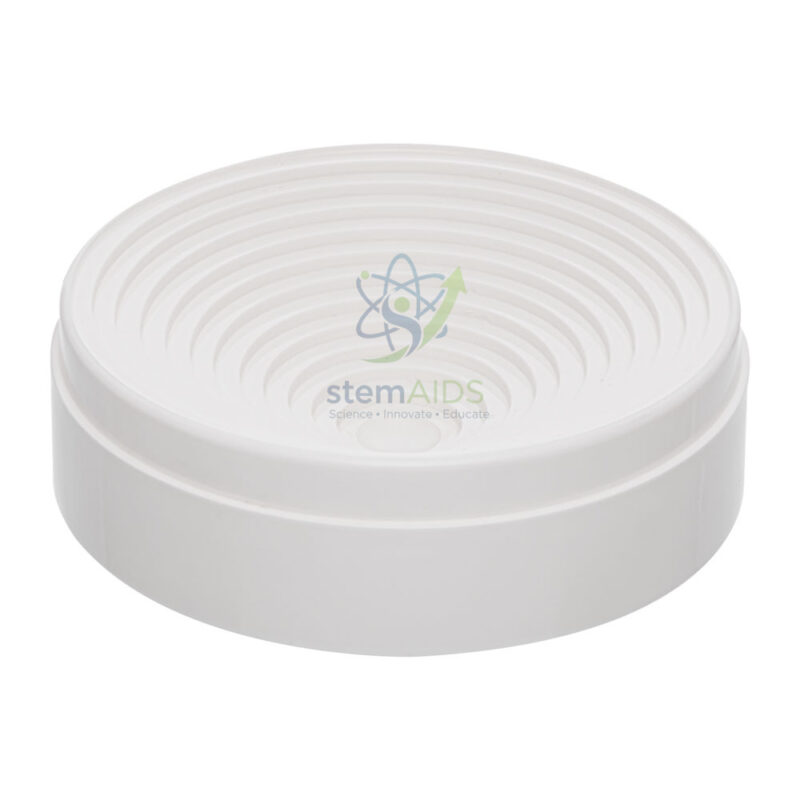
Quick Answer: A plastic flask stand is a ring-shaped support with stepped, concentric ledges on which a round bottom flask sits upright. The listing image shows a circular stand with several steps, so one stand can take flasks of different sizes.
Keeping Round Bottom Flasks Upright
A round bottom flask will not stand on a bench by itself. Traditionally it rests in a cork ring, which works but takes only one size, absorbs spills and eventually crumbles. A stepped plastic stand does the same job for a range of flask sizes: small flasks drop into the inner step, larger flasks sit on the outer ones, and the stand’s wide base resists tipping.
The title does not name the plastic. Polypropylene and polyethylene stands wipe clean, do not absorb chemicals and can be rinsed under the tap. They are not intended to take a flask straight from a heating mantle or oil bath, so let hot flasks cool in a clamp or on a cork ring first unless the stand’s temperature limit is known.
Multi-neck flasks such as the two or three neck flask become top-heavy once condensers and funnels are fitted, so the stand is for the empty or simply stoppered flask; clamp the neck whenever apparatus is attached.
Care & Handling
- Place the flask centrally so it rests on one complete step.
- Wipe spills at once and rinse the stand with water; plastic does not soak up liquids the way cork does.
- Do not rely on the stand for a flask with apparatus attached; clamp the neck to a retort stand.
Specifications
| Item | Stepped ring stand for round bottom flasks |
| Design | Concentric steps in a circular base, as shown in the listing image |
| Material | Plastic, as titled; grade not stated |
| Heat | Not for flasks taken straight from heating |
Applications
- Holding a round bottom flask while it is weighed empty and again after adding reagents
- Filling flasks through a funnel before a reflux or distillation set-up is assembled
- Resting flasks of cooled product before crystallisation
- Storing clean round bottom flasks on shelves without them rolling
Why Choose LabEquip
Organic chemistry labs with many round bottom flasks of mixed sizes use stepped stands in place of a drawer full of cork rings. LabEquip lists the stand with its chemistry lab equipment; ask about the sizes it takes through the contact page.
Related Products
- Flask Stand, Silicon: A silicone rubber flask stand that cushions the glass and copes better with warm flasks than plain plastic.
- Flask, Boiling, Round Bottom: A round bottom boiling flask, the curved-base flask this stepped stand is designed to hold upright.
- Flask, Boiling, Two/Three Neck (Round/Flat Bottom): A two or three neck boiling flask that can rest on the stand while empty but needs clamping once fitted out.
- Round Bottom Flask 250ml: A 250 ml round bottom flask that sits on one of the stand’s inner steps.
Frequently Asked Questions
How does a stepped flask stand hold flasks of different sizes?
The stand has several concentric ledges, as the listing image shows. A small round bottom flask drops into the inner step, while larger flasks rest on the outer rings, so the curved base always touches a ring rather than a flat surface. One stand therefore does the work of several single-size cork rings.
Is a plastic flask stand better than a cork ring?
A cork ring takes only one flask size, absorbs spilt chemicals and slowly crumbles. A plastic stand takes a range of sizes, does not soak up liquids and can be rinsed under the tap. Cork is still useful for hot flasks if the plastic’s temperature limit is unknown, because cork insulates and tolerates heat.
Can I put a hot flask straight onto a plastic flask stand?
No. A flask taken straight from a heating mantle, oil bath or burner can soften or mark the plastic. Let hot flasks cool in a clamp on the retort stand or on a cork ring first, then move them to the plastic stand once they can be held comfortably in the hand.
Will a stepped stand keep a multi-neck flask stable?
A two or three neck flask becomes top-heavy once a condenser, funnel or thermometer is fitted, and a ring stand alone will not stop it tipping. Use the stand for the empty or lightly loaded flask, and clamp the neck to a retort stand whenever apparatus is attached to it.
How do I clean a plastic flask stand after a spill?
Rinse it under running water, wash with a mild detergent and a soft brush, then rinse with distilled water and let it dry. Avoid scouring pads and strong solvents, which can scratch or cloud the plastic. Wipe spills promptly so corrosive liquids do not sit in the grooves between steps.
Can the stand hold a volumetric or flat bottom flask?
Flat bottom and volumetric flasks stand on their own bases, so they do not need a ring stand, although the stand can steady a flat base that is wet or on a sloping surface. The stepped design is made for curved bases, so its real use is with round bottom and pear-shaped flasks.
Last Updated: November 2026




Reviews
There are no reviews yet.